EPIAUR-PEA-20260724-AP-001

Epipremnum aureum ‘Pearls and Jade’

0
QR code

Repotting Planner

Cadence: Every 2 years · From definition

Primary: Not assigned · Alternate: Not assigned

No eligible windows assigned. Configure the definition first.

Care Cadences

Live definition defaults with your instance care settings.

4 of 6 care decisions resolved

WateringEvery weekFrom definitionNext due: Nov 27, 2026
FertilizingNot scheduled
RepottingEvery 2 yearsFrom definitionNext due: Not established
Pest inspectionEvery monthFrom definitionNext due: Nov 28, 2026
General inspectionEvery 2 weeksFrom definitionNext due: Not established
PruningNot scheduled

Potted-together history

This specimen carries forward the current lifecycle while each constituent retains its original historical record.

Potted together · Aug 28, 2026

Acquisition & provenance

The canonical record of how this specimen entered the collection.

Acquired: Jul 25, 2026

Acquisition label: Pothos Pearls and Jade

Seller: Plantrums

Channel: Plantrums

Sources: Plantrums (Propagator)

Price: USD 5.16

Linked acquisition: cms3pc6rj000413mpt4isr4td

Identity

Epipremnum aureum ‘Pearls and Jade’

Confidence: uncertain

Author citation: (Linden & André) G.S.Bunting

Status: ACTIVE

Type: Acquired propagation

Location: LOC-RM-06 · Work Office

Acquired: Jul 24, 2026

Propagated: Jul 22, 2026

Stock: —

View lineage graph

Aliases

Pearls and Jade pothos · common name · probable

Pothos aureus · synonym · confirmed

devil’s ivy · common name · confirmed

golden pothos · common name · confirmed

pothos · common name · confirmed

Current substrate

Aroid Mix v1

Substrate library
Coco 25%Coarse perlite 15%Pumice 20%Medium bark 35%Castings 5%
Substrate history (1)

Aroid Mix v1

Aug 27, 2026 · Repotting

Specimen photos

Choose one cover photo for this specimen card. Admins can also mark one specimen photo as the type photo for the plant definition.
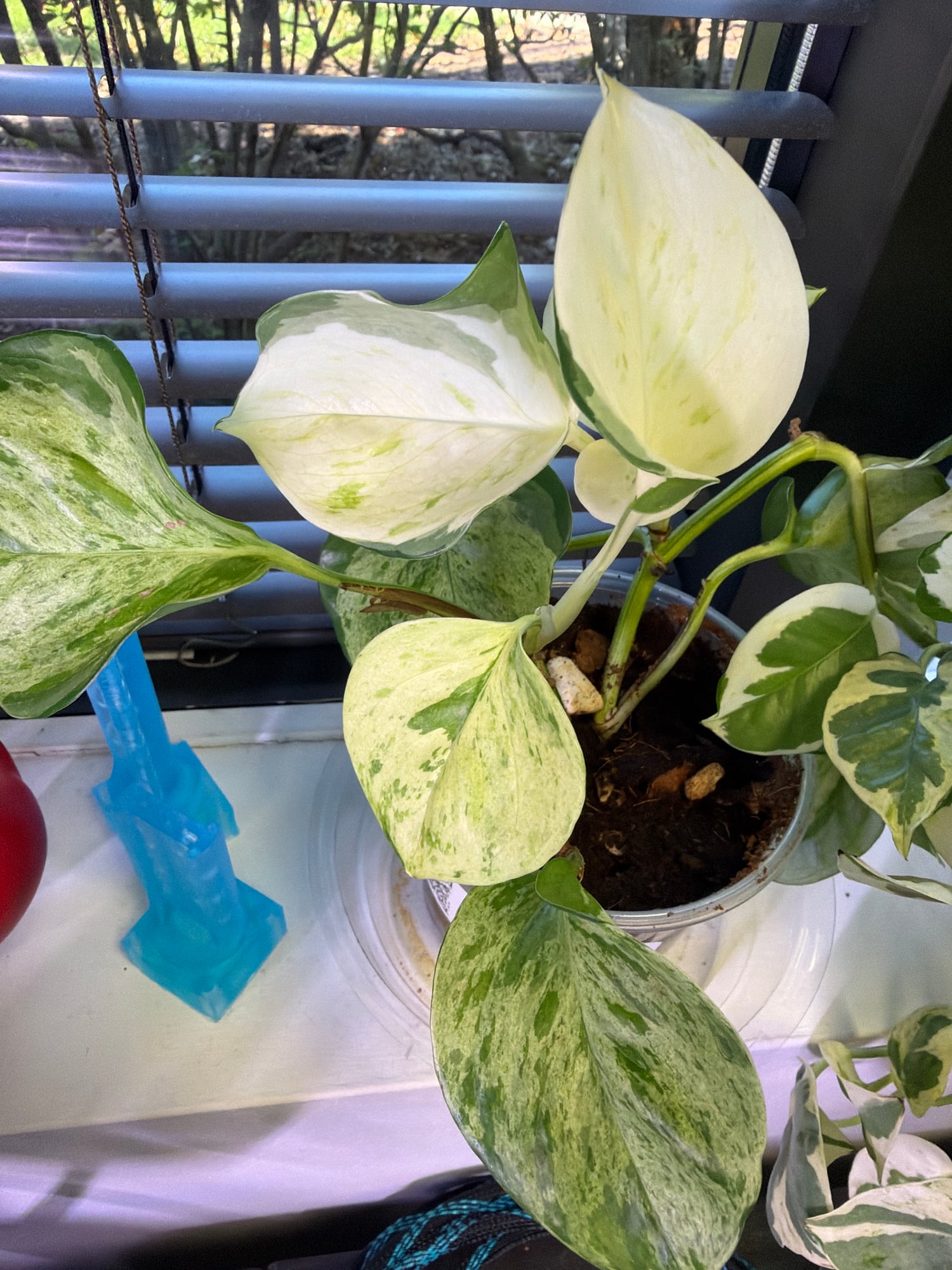
Variegated potted plant near window

Variegated potted plant near window

Not cover · Not type

Plant Health Timeline

A deterministic record of care, observations, blooms, documentation, and lineage activity for this specimen.

41 events

Timeline status

Recently active

Health trend

Healthy

Age in collection

119 days

Last observation

Today

Last watering

Today

Last photo

31 days

Last bloom

No data

Bloom cycles

0

Propagations produced

0

Unresolved issues

0

Watch items

0

Longest quiet period

12 days

Jul 22, 2026Nov 20, 2026
Life Story listOpen

July 2026

August 2026

September 2026

October 2026

November 2026

Quarantine

Quarantine records are manual workflow records; moving a plant does not start or release quarantine by itself.

No active quarantine record.

Care

Last watering, open conditions, and recent care history.

Last watered

Nov 20, 2026

Next estimate

Nov 27, 2026

Open conditions

0

Recent care history

watered · Nov 20, 2026

Recorded via bulk care batch.

watered · Nov 13, 2026

watered · Nov 4, 2026

pest check · Oct 28, 2026

watered · Oct 27, 2026

watered · Oct 20, 2026

Recorded via bulk care batch.

watered · Oct 8, 2026

watered · Sep 28, 2026

Recorded via bulk care batch.

Husbandry

Inherited from this plant definition.

Water when partly dryBright indirect lightToxic to pets

Easy trailing houseplant; let the top layer dry, give bright filtered light, and prune to keep full.

Location compatibility

Review recommended

Advisory

Some recorded conditions are worth reviewing. You can still use this location.

Temperaturematch

The recorded location range sits within the plant’s preferred range.

Plant: 13–29 °C · Location: 21–24.5 °C

Nighttime temperatureunknown

There is not enough structured nighttime temperature data to compare.

Plant: Unknown · Location: 18.5–22 °C

Humiditycaution

The ranges overlap, but part of the recorded location range falls outside the plant’s preference.

Plant: 40-60% · Location: 39-55%

Light measurementunknown

There is not enough structured light measurement data to compare.

Plant: Unknown · Location: Unknown

Photoperiodunknown

There is not enough structured photoperiod data to compare.

Plant: Unknown · Location: 12-12 h

Light intensitymatch

Recorded light intensity matches the structured preference.

Plant: bright · Location: bright

Light exposurecaution

Recorded exposure is reasonably compatible, though seasonal changes may matter.

Plant: indirect · Location: mixed

Airflowmatch

No clear airflow conflict is recorded.

Plant: Avoid drafts · Location: moderate

Stabilitymatch

No clear stability conflict is recorded.

Plant: stable · Location: stable

Missing comparison data: Nighttime temperature, Light measurement, Photoperiod.

Full husbandry guideOpen

Full husbandry guide

Inherited from plant definition

Quick summary

Water
Water when partly dry
Light
Bright indirect light
Toxicity
Toxic to pets
Care notes
Easy trailing houseplant; let the top layer dry, give bright filtered light, and prune to keep full.

Watering

Cadence
Typically every 7–14 days indoors, depending on light and pot size.
Moisture level
Keep lightly moist; allow the top 1–2 in (2.5–5 cm) to dry before watering again.
Drought tolerance
Moderate; wilts before severe damage but dislikes prolonged dry periods.
Wet/dry cycle notes
Water thoroughly, then drain completely; do not leave standing in water.
Seasonal adjustments
Reduce frequency in winter or low light; increase slightly in warm bright conditions.

Light

Intensity
Bright indirect light; tolerates medium light but variegation is better in brighter conditions.
Duration
About 10–14 hours of bright ambient light daily.

Temperature and hardiness

USDA zone
10–12 outdoors; commonly grown as an indoor plant elsewhere.
Cold tolerance
Best kept above 55 °F (13 °C); growth slows and injury risk rises below this.
Heat tolerance
Handles typical indoor warmth well up to about 85 °F (29 °C) with adequate humidity.
Frost sensitivity
Frost-tender; avoid any freezing temperatures.
Overwinter instructions
Keep warm, away from cold windows and drafts; water less and avoid soggy media.

Humidity

Range
Average indoor humidity to about 40–60% preferred.
Dry air tolerance
Moderate; usually tolerates dry indoor air but leaf edges may crisp in very dry rooms.
Misting notes
Misting is optional and has limited benefit; better use a humidifier or pebble tray if needed.

Soil and medium

Preferred medium
Loose, airy, well-drained aroid mix.
pH preference
Slightly acidic to neutral, about pH 6.0–7.0.
Drainage needs
High drainage with good aeration.
Growth substrate habit
Epiphytic climber/trailer with aerial roots.
Substrate recipe notes
Use potting mix amended with bark, perlite, and/or coco chips to prevent compaction.

Fertilization

Type
CREATE_NEW_RECIPE
Strength
Light feeder; use about 1/4–½-strength balanced houseplant fertilizer.
Frequency
Every 4–6 weeks in active growth, or less if growth is slow.
Seasonal schedule
Feed spring through early fall; pause or greatly reduce in winter and low light.
Micronutrient notes
A complete fertilizer with micronutrients is helpful; watch for salt buildup and flush occasionally.

Repotting

IntervalLocal adjustmentEdit care cadence
Every 2 years
Preserved legacy guidance: Every 1–2 years, or when rootbound.
Inherited: Every 1–2 years, or when rootbound.
Pot type
Use a pot with drainage holes; one size up is usually enough.
Root sensitivity
Moderately root-tolerant but prefers minimal disturbance.
Dormancy consideration
Repot during active growth if possible; avoid heavy root work in cool, dark months.
Division guidance
Usually propagated by cuttings rather than division; separate only if multiple rooted stems are present.

Propagation

Preferred methods
Stem cuttings, node cuttings, water rooting, or direct-to-media rooting.
Difficulty
Easy.
Expected success
High with a healthy node and warm bright conditions.
Optimal timing
Spring to summer, or any time indoors with stable warmth and light.
Rooting hormone notes
Optional; not usually necessary for pothos cuttings.
Tissue culture notes
Possible in production, but not needed for home or collection use.

Pests and disease

Common pests
Spider mites, mealybugs, scale, thrips, and fungus gnats.
Common diseases
Root rot, bacterial leaf spot, and opportunistic fungal leaf issues.
Treatment notes
Remove damaged tissue, improve airflow and drainage, and treat pests with insecticidal soap or horticultural oil as needed.
Susceptibility level
Low to moderate; generally resilient but sensitive to overwatering and low light.
Preventative practices
Provide bright indirect light, avoid overwatering, inspect new plants, and keep foliage clean.

Toxicity

Pets
Toxic if ingested by cats and dogs; can cause oral irritation and GI upset.
Humans
May irritate skin and mouth if chewed or handled roughly.
Sap irritant
Sap may be a mild skin and eye irritant.
Edible?
Not edible; not for food use.

Dormancy and blooms

Dormancy behavior
No true dormancy; growth slows in cooler, darker months.
Typical bloom season
Rare indoors; flowering is uncommon in cultivation.
Bloom duration
If it blooms, the inflorescence is short-lived.
Fragrance
Usually not noticeable indoors.
Rebloom tendency
Very uncommon in typical home conditions.
Bloom triggers
Mature plants, bright warm conditions, and substantial climbing growth may encourage flowering.
Pollinator notes
Not usually relevant in indoor culture.

Growth habit

Growth habit
Trailing or climbing vine with heart-shaped variegated leaves.

Conservation and collection status

Rarity
Common in the houseplant trade; cultivar availability is widespread.
Conservation status
Not assessed here; widely cultivated and not generally considered rare in trade.
Reference links
https://powo.science.kew.org/taxon/urn%3Alsid%3Aipni.org%3Anames%3A87014-1 ; https://www.inaturalist.org/taxa/69223-Epipremnum-aureum ; https://www.gbif.org/taxon/6FWKS
Protected species notes
No special protection status assumed from the provided data.
Collection restrictions
Check local rules for plant import, quarantine, and biosecurity before moving live material.
Import/export concerns
May be subject to phytosanitary requirements; inspect for pests and soil restrictions.
Invasiveness
Can naturalize or become invasive in suitable tropical climates; do not release outdoors where risky.
Native range notes
Species is associated with tropical Southeast Asia in cultivation references; exact range details may vary by source.

Sport / mutation

Status: NONE

No sport observations yet.

Parents

No parent propagation recorded.

Children

No child propagations yet.

Add note

Reminders

Send yourself plant check-in emails tied to this specimen.

All reminders

Sign in to schedule reminders.

No reminders for this plant yet.

Bloom tracker

Open a bloom when it starts, mark peak later, then close it when finished. Photos can be added to the bloom event at any stage.

No bloom events recorded yet.